
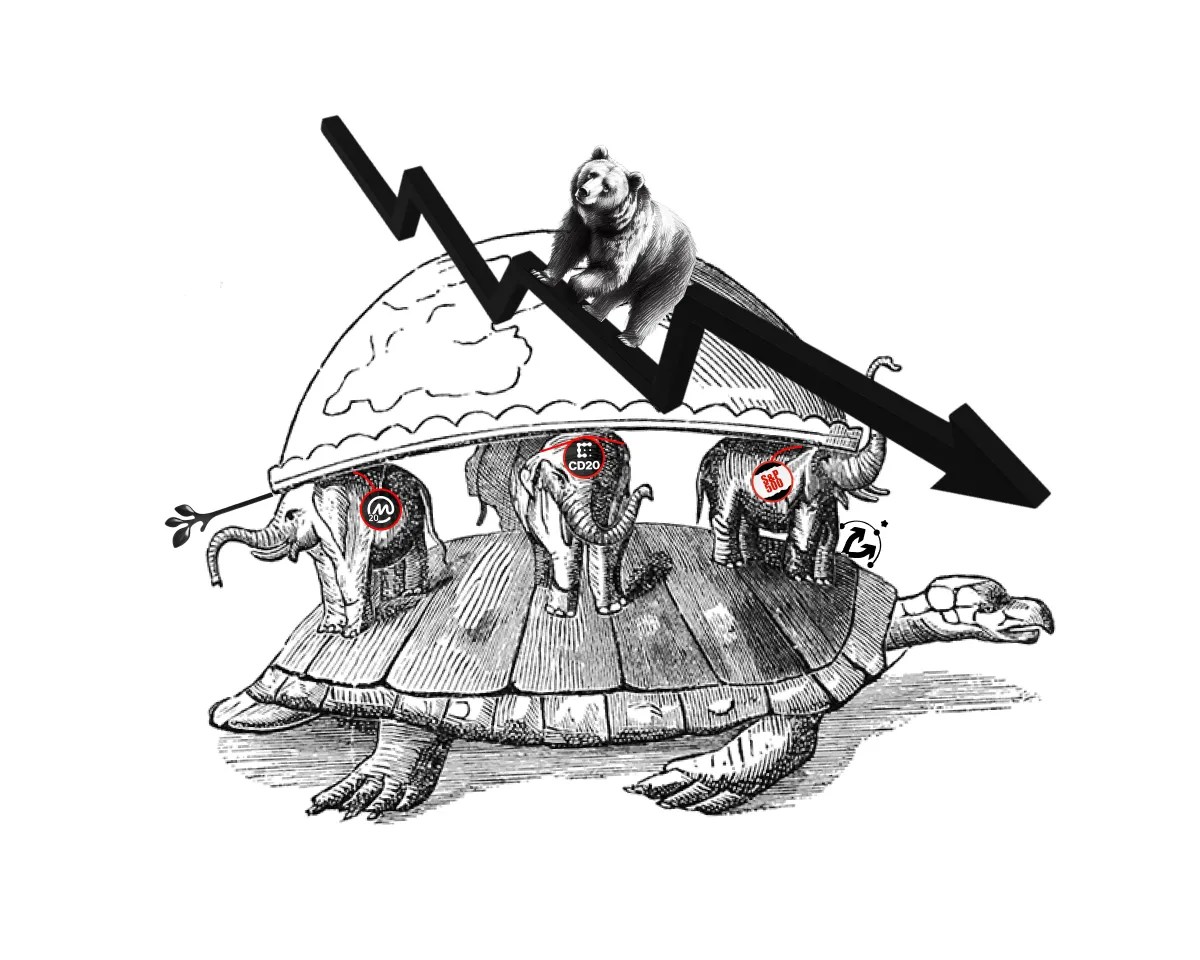
How Crypto Indices Help in a Bear Market
In the ever-evolving landscape of finance, market gauges like the Dow Jones Industrial Average (DJIA) and the S&P 500 have stood the test of time. Though conceived over a century ago, they remain relevant as tools for macro assessments of market dynamics. In the context of cryptocurrency, indices have donned a new coat of innovation, becoming invaluable for investors seeking to navigate the turbulent waters of bear markets.
Understanding Market Dynamics Through Indices
Just as traditional indices offer investment flexibility through various funds and portfolios, crypto indices have emerged as a promising solution for those grappling with downturns. The advent of blockchain technology and programmable tokens has ushered in a new era of accessibility and functionality within indices, especially in the Web3 environment. This transformation is crucial in enabling investors to balance exposures by sector and theme.
ForkLog provides an in-depth analysis of how aggregated financial instruments have evolved, surveying the rise of crypto-index platforms, DIY portfolios packaged in “NFT containers,” and automated yield strategies tailored for bear markets.
A Brief History of Indices: From Paper to Digital
The evolution of indices is a fascinating narrative. The first substantial step came in the late 19th century, when Dow Jones & Company employees realized they were spending excessive time compiling daily reports on large companies’ share prices. Charles Dow, one of the company’s co-founders, introduced the Dow Jones Transportation Average in 1884, reflecting the state of the railway sector—the backbone of that era’s economy.
By 1896, together with Edward Jones, Dow expanded this concept with the DJIA, an arithmetic average of the share prices of 12 leading enterprises, which eventually grew to include 30 blue chips in 1928. This pioneering work laid the groundwork for modern analysis of market dynamics.
Key Indices Over Time
The historical trajectory of indices shows how the need for more precise tools developed over subsequent decades.
- 1950: The Nikkei 225 was introduced, reflecting Japan’s economic miracle and the sharp bubbles of the late 1980s.
- 1957: Standard & Poor’s launched the S&P 500, employing a cap-weighted methodology that has become standard in market aliases today.
- 1971: The NASDAQ Composite arrived, capturing the burgeoning technology sector.
- 1980s and 1990s: Indices such as the Russell 2000 and the EURO STOXX 50 emerged to track specific segments of the market.
However, it wasn’t until the 1970s that direct investment in indices became possible. John Bogle founded Vanguard and created the first index fund, which led to the launch of the first ETF—SPDR S&P 500—in 1993.
Strategies and Opportunities in Bear Markets
Bear markets often lead to risky behavior, where investors chase returns without considering underlying metrics. Notable lessons from history are etched into investor memory—Japan’s Nikkei 225 took over three decades to surpass its 1989 heights, while the dot-com bubble and the 2008 financial crisis highlighted the dangers of misinterpreting risk metrics.
Current market conditions echo similar warnings. The concentration of wealth among leading firms within indices can create an illusion of strength. According to data from Slickcharts, on March 3, 2026, around 36.6% of the S&P 500’s weight was in its top ten companies, suggesting that declines among these giants could spell trouble for overall market health.
The Impact of Events on Indices
Recent geopolitical tensions offer real-time examples of how indices react under pressure. For instance, consider the outbreak of hostilities in Iran in early 2026 and its repercussions on global oil markets. On February 28, a joint military operation initiated by the US and Israel created an immediate expectation for energy prices to rise, particularly in light of attacks on crucial oil infrastructures like the Saudi Aramco refinery.
Investors utilized indices to hedge risks and respond swiftly to these volatility drivers, enabling them to make informed decisions without the guesswork of individual stock analysis.
The Evolution of Crypto Indices
In the cryptocurrency realm, the journey of indices began in earnest around 2013. CoinDesk released the Bitcoin Price Index (XBX), followed by initiatives like Winkdex and the NYSE Bitcoin Index, marking increased legitimacy and interest from traditional financial sectors.
Fast forward to contemporary times, and crypto indices have evolved into powerful tools for investors seeking diversified exposure to the digital asset ecosystem. Innovations such as CoinDesk 20 and CoinMarketCap’s CMC20 have emerged, with the latter allowing investors to own “the entire market” with a single transaction—streamlined through automatic rebalancing via smart contracts.
Harnessing the Power of NFT Containers
Another innovative route in the crypto index realm is the use of NFT containers. Wrapped NFTs (wNFTs) have transformed static portfolios into programmable wallets, streamlining the management of investments while maintaining decentralization and control. Platforms like Envelop enable users to bundle various assets into a single NFT, creating a streamlined investment vehicle that offers opportunities for yield generation.
Vaults and tokenization features notably advance this functionality, allowing users not only to hold assets passively but actively yield returns. For example, the Solv Protocol employs semi-fungible tokens to encapsulate complex investment strategies, increasing both efficiency and potential ROI.
Navigating Bear Markets with Data and Strategy
The merging of traditional analytical methods with modern technological advances offers a fresh perspective on managing crypto assets during challenging market conditions. Strategies that once proved effective in equities can now be adapted to digital currencies, empowering investors with the tools and knowledge necessary to mitigate risks and navigate market turbulence adeptly.
Although new technologies provide pathways for growth and capital security, the fundamental principles of analysis and risk management remain crucial. Every investor must balance innovative approaches with tried-and-true strategies for success.
Exploring the intricate world of crypto indices not only sheds light on contemporary investments but also echoes timeless principles of market assessment—proving invaluable in times of uncertainty.


