

The Crypto Fear & Greed Index fell to 5 on Thursday, signaling a sharp deterioration in market sentiment as digital asset prices continue to slide.
This decline reflects intensifying panic among investors, with risk appetite eroding amid broader global market uncertainty.
Sponsored
Crypto Sentiment Sinks Deeper Into “Extreme Fear”
The Crypto Fear & Greed Index is an essential gauge for measuring the emotional landscape of the cryptocurrency market, operating on a scale from 0 to 100. Readings between 0 and 24 indicate Extreme Fear, while 25 to 49 signal Fear, 50 represents Neutral, 51 to 74 reflects Greed, and 75 to 100 denote Extreme Greed.
At 5, the current index reading firmly places the market in Extreme Fear territory. This latest drop comes on the tail of a steady decline in sentiment over recent weeks, revealing just how quickly confidence has unraveled.
Just a month ago, the index was at 26, already in the Fear range. In the past week, it slid to 12 and registered an 11 just a day before hitting its current low. This rapid deterioration reflects a market moving in turmoil, driven largely by the economic landscape.
The collapse in crypto sentiment aligns closely with the rising tide of global economic anxiety. For example, the World Uncertainty Index tracks how often the term “uncertainty” appears in Economist Intelligence Unit country reports. Covering over 140 countries, it presents a quarterly, cross-country indicator that serves as a vital tool for both macroeconomic research and global risk analysis.
In the third quarter of 2025, this index soared to an unprecedented high above 100,000. The following quarter saw it at 94,947, levels double the peaks observed during major crises such as the COVID-19 pandemic, Brexit, and the Eurozone debt crisis.
Sponsored
“Rising geopolitical tensions, volatile markets, and policy uncertainty are driving the spike, as investors struggle to price in what comes next,” Coin Bureau wrote.
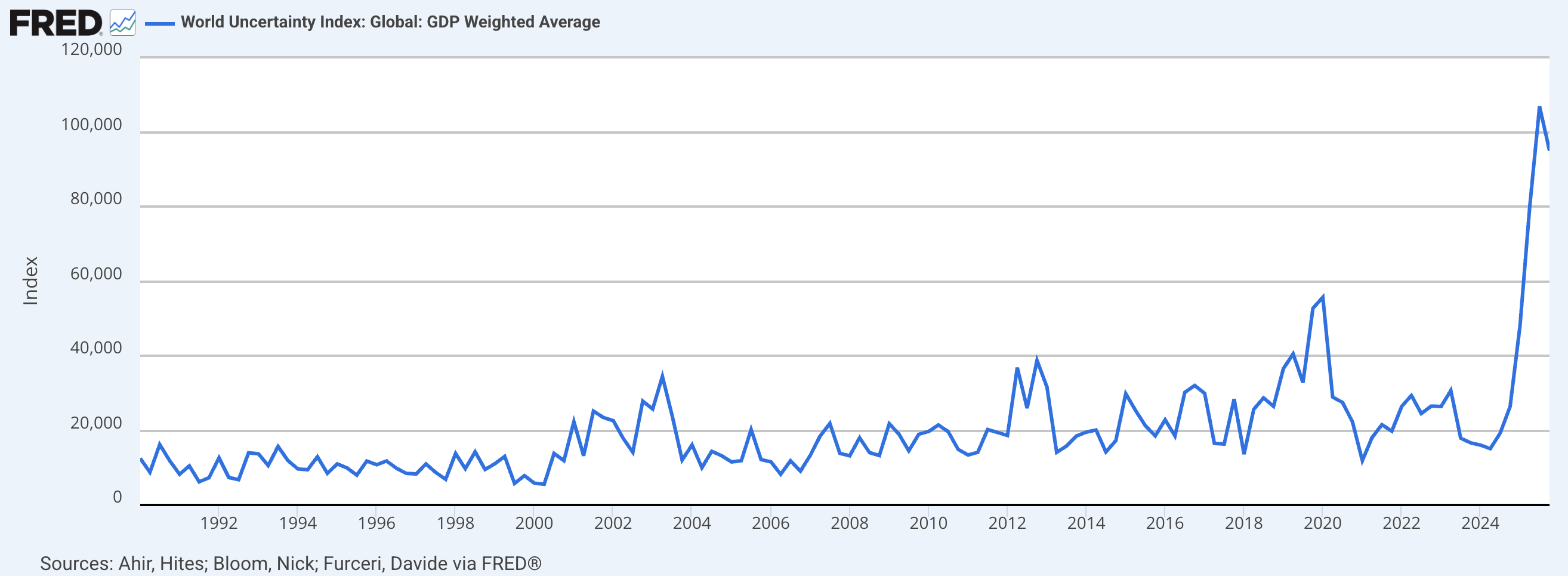
This elevated reading from the World Uncertainty Index signals heightened anxiety across global markets. Investors are grappling with unpredictable economic and political conditions that have driven them to retreat from risk assets, including cryptocurrencies.
Crypto Market Cap Falls 22% in 2026 as Bitcoin and Ethereum Extend Losses
This stark decline in sentiment dovetails with the broader trend of decreasing prices across the crypto market. In 2026 alone, total market capitalization has plummeted by over 22%, undoing the positive momentum witnessed at the year’s onset.
Sponsored
Bitcoin, which started the year strong, ended January down more than 10%. February has not fared better, with an additional 14.6% decline to date. Ethereum has suffered as well, marking a staggering 33.8% drop year-to-date. This enduring downturn has significantly impacted overall market activity.
Analysts Weigh Crypto Market’s Next Move
As uncertainty permeates these bear market conditions, analysts are grappling with predictions for the next moves in the crypto landscape. Notably, Kyle Chassé highlighted the historical parallels, noting that similarly depressed readings on the Crypto Fear & Greed Index occurred in 2018, March 2020, and after the FTX collapse in 2022.
Sponsored
“Every time, it marked a massive opportunity window. No, it doesn’t guarantee the bottom. But historically, peak fear is where asymmetry lives,” he said.
Further analysis from various experts posits that the current downturn may represent a shakeout phase before a potential breakout; however, the timing and nature of any recovery remains clouded in uncertainty. Ray Youssef, CEO of NoOnes, suggested that Bitcoin could trade sideways until summer 2026, indicating the market has entered a more extended reassessment of risk.
Youssef pointed to structural factors influencing this landscape, such as US political and monetary cycles, persistent inflation constraints, weakened retail capital flows, and cautious institutional interest following substantial losses.
“As a result, we are unlikely to see a V-shaped reversal before the summer of 2026. More likely, we will see regular rebounds, triggered by short-covering and short squeezes,” he summarised.
According to Youssef, while such rebounds could range between 20% and 30% and may be sustained, they could also serve as bull traps, leading investors to rethink their strategies. Additionally, he warned that the crypto market typically endures a lengthy accumulation phase within a single range before entering a true bull market.